In This Article
There is a running joke among Morocco travellers: Casablanca is the city everyone passes through and nobody stays in. The airport transit lounge at Mohammed V International is one of the most well-travelled spaces in Africa, and yet the city around it remains largely unknown to the visitors who stream through it toward Marrakech, Fes and the Sahara.
This is a genuine loss. Casablanca is Morocco's largest, most economically powerful and most internationally-minded city — a 4-million-person metropolis that feels unlike anywhere else in the country. It is not the Morocco of medinas and camels and desert camps. It is the Morocco of Art Deco boulevards, rooftop bars, the world's third-largest mosque rising from the Atlantic, and a restaurant scene that is quietly becoming one of the most interesting in North Africa. Give it two days. You will not regret it.
The City Nobody Stays In
The irony of Casablanca's tourist reputation is that the famous 1942 film was not shot here — it was made entirely on a Hollywood backlot in California, and the film's aesthetic owes nothing to the actual city. Casablanca the film is about a nightclub called Rick's. Casablanca the city is about something far more interesting: the collision of French colonial modernism, Moroccan Islamic tradition, African commerce and 21st-century ambition.
Founded as a significant city during the French Protectorate (1912–1956), Casablanca was built to be Morocco's economic engine — a modern port city designed by French urban planners with wide boulevards, ornate administrative buildings and a planned grid that still makes it the easiest Moroccan city to navigate. The French left; the city kept growing. It now generates approximately 50% of Morocco's GDP and is home to the headquarters of nearly every major Moroccan company.
Hassan II Mosque — Essential
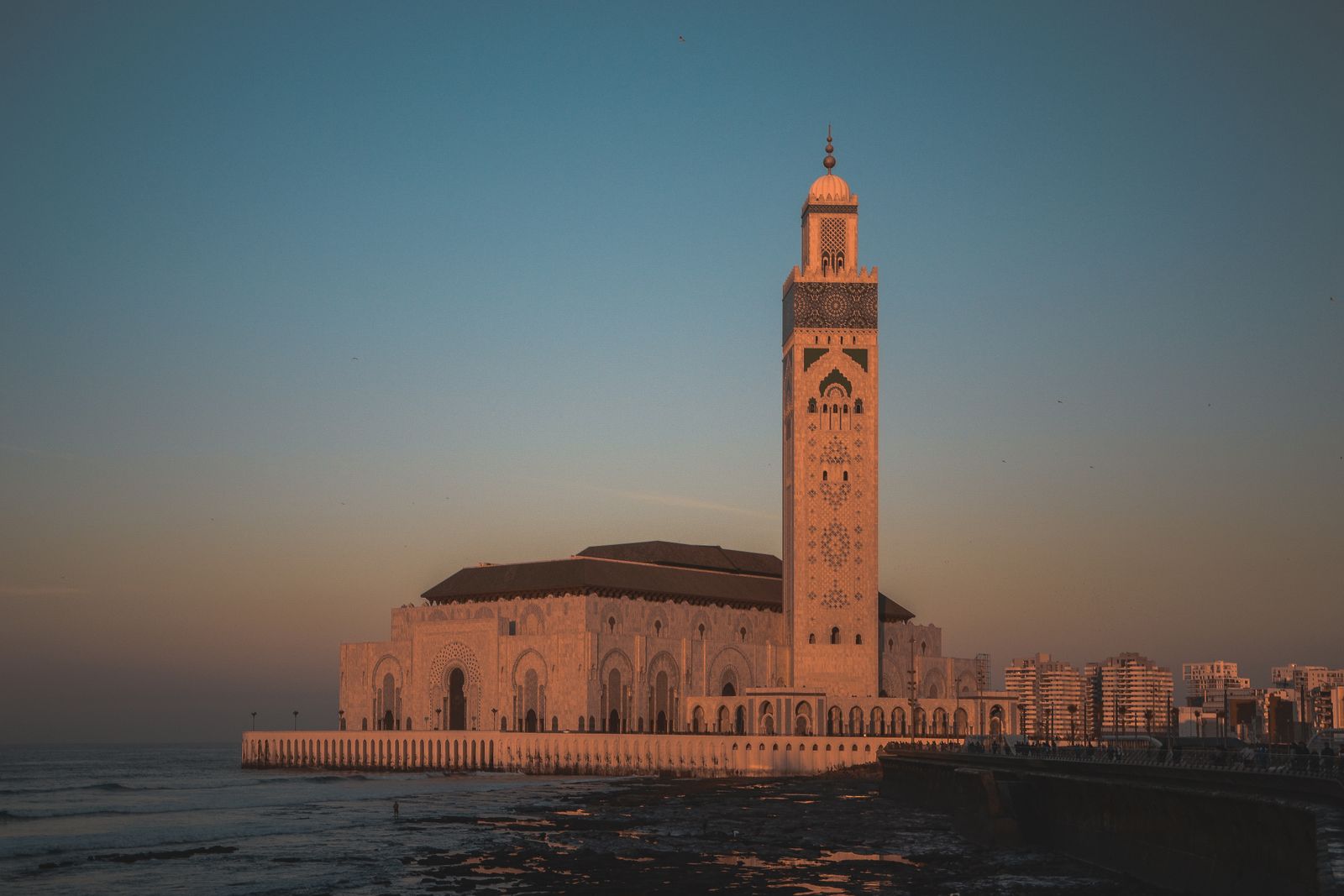
The Hassan II Mosque is the reason most tourists who do stay in Casablanca cite for coming — and it is entirely sufficient reason on its own. Completed in 1993 after six years of construction, it is the world's third-largest mosque (after Mecca and Medina) and the largest anywhere that non-Muslims can enter.
The interior is extraordinary: 50,000 square metres of zellige tilework on the floors and lower walls, carved stucco panels reaching 20 metres high, a retractable roof that opens to the sky on clear days, and a hammam and library below the main prayer hall. The guided tour takes approximately 90 minutes and is worth every dirham — the guide provides context that transforms the architecture from impressive to genuinely moving.
Art Deco Casablanca
Between 1912 and 1956, French architects built Casablanca as a showcase of modernist urban planning, and the Gauthier and Maarif neighbourhoods contain one of the finest collections of Art Deco architecture outside Miami's South Beach. The style here has a specifically Moroccan flavour — Moorish arches and geometric zellige details applied to Art Deco facades in a hybrid that has no parallel anywhere else.
The self-guided walking tour: start at Place Mohammed V (the grand civic square, surrounded by the Préfecture, Wilaya and Palais de Justice buildings) and walk north along Boulevard Mohammed V to Boulevard Moulay Youssef. The most concentrated Art Deco streetscape in Morocco lies within a 1km radius of this intersection. Look up — the street-level shops often hide extraordinary facades above them.
Key buildings: the Assayag Building (1930, extraordinary curved facade), the Rialto Cinema (1930, now a cultural centre), the Central Market (Marché Central, 1917, still functioning as a fresh produce and fish market). None requires a ticket — all are on public streets.
The Corniche
The Ain Diab Corniche is Casablanca's seafront boulevard — 3km of restaurants, beach clubs, cafés and promenading Casawis (Casablanca residents) stretching along the Atlantic coast southwest of the city centre. It is Morocco's most glamorous waterfront and bears no resemblance to anything in the medina cities to the south.
The beach clubs (La Fibule, Tahiti, Miami Beach Club) offer sun loungers, pools and fresh seafood restaurants. Day access: 80–150 MAD including sun lounger. The seafood restaurants along the Corniche serve the freshest Atlantic fish in Morocco — sea bass, sole, sardines and the Casablanca speciality, pastilla de fruits de mer (a seafood version of the classic pigeon pastilla that is a genuine local invention).
The Old Medina
Casablanca's medina is the most relaxed in Morocco for visitors — it is small, mostly residential, has very few tourist shops and essentially no touts. It was largely built in the late 19th–early 20th century and lacks the medieval grandeur of Fes or Marrakech. But it is precisely this ordinariness that makes it valuable: you can wander freely, buy from local shops at local prices, eat at small restaurants with handwritten menus, and experience a Moroccan neighbourhood that has no interest in performing for visitors.
The Nouvelle Médina (Quartier des Habous), 2km south of the old medina, is more architecturally interesting — a 1930s planned quarter designed by French architect Albert Laprade in a deliberately Moroccan style. The result is an elegant pastiche of traditional Moroccan urbanism: covered souks, small mosques, carved wooden balconies — all built with 20th-century construction standards. The best bookshops in Casablanca are here, along with excellent patisseries and a low-key artisan souk.
Eating Like a Casawi
Casablanca has Morocco's most cosmopolitan food scene — a consequence of its size, international business community and proximity to the Atlantic. The city has excellent French, Italian, Japanese and Lebanese restaurants alongside Moroccan cuisine. But the specifically Casawi dishes are worth seeking out:
- Pastilla de fruits de mer — A Casablanca invention: layers of warqa pastry filled with seafood (prawns, mussels, squid) in a cream sauce, baked until golden. Available at most upscale Moroccan restaurants on the Corniche. 120–180 MAD.
- Sardines at La Sqala — The historic 18th-century city wall fortress-turned-restaurant serves the best grilled sardines in the city. 80–120 MAD for a full lunch.
- Rick's Café — The famous bar from the 1942 film did not exist. American Kathy Kriger opened a restaurant named Rick's Café in 2004. It is atmospheric, has excellent cocktails, live piano, and serves decent Moroccan-international fusion. 300–500 MAD for dinner. Worth visiting once for the conceit of it.
- Breakfast at any café in Gauthier — French-Moroccan cafés serving croissants, pain au chocolat, fresh orange juice and café au lait. The most civilised breakfast in Morocco, 30–50 MAD.
Day Trips from Casablanca
- Rabat — 45 minutes by train (ONCF, 45 MAD), Morocco's elegant capital with the Hassan Tower, Mohammed V Mausoleum and a calm medina. The best day trip from Casablanca.
- El Jadida — 90 minutes south by train (90 MAD). The Portuguese Cité Portugaise — a UNESCO World Heritage 16th-century fortified town with an extraordinary underground cistern that doubled as a film set for Orson Welles' Othello.
- Azemmour — 90 minutes south (change at El Jadida). A little-visited blue-and-white medina on the Oum Er-Rbia river. One of Morocco's best-kept secrets.
Practical Guide
- Getting around: Casablanca has an excellent tramway (T1 line connects the train station, Mohammed V square and Corniche). Petit taxis are metered and reliable. Careem (the regional Uber) works well.
- Where to stay: The Gauthier and Maarif neighbourhoods are the most pleasant for visitors — walking distance to Art Deco sights, restaurants and the tram. The Corniche is convenient for beach access.
- How long to spend: Two nights allows the Hassan II Mosque, an Art Deco walk, the Corniche and a Rabat day trip. One night is sufficient for the mosque and a good dinner.