In This Article
Essaouira operates at a frequency that is entirely its own. Where Marrakech overwhelms and Fes disorients, Essaouira simply draws you in — with the smell of salt air and grilling sardines, the sound of the Atlantic crashing against 18th-century sea walls, the perpetual hum of trade winds that have blown here since before the Phoenicians first landed on this coast. It is the most relaxed city in Morocco, the most artistic, and — when the wind drops and the late afternoon light catches the white walls and blue boats of the fishing harbour — the most quietly beautiful.
Two nights in Essaouira is the minimum. Three is better. A week is not unusual for visitors who arrived planning two days.
Why Essaouira is Different
Essaouira's character was shaped by two things: its geography and its history. The city sits on a headland jutting into the Atlantic, exposed to the alizés — the trade winds that blow reliably from the north at 20–40 km/h almost every afternoon. These winds made Essaouira (ancient Mogador) a crucial stopping point for trans-Atlantic and African trade routes, but they also gave it a specific atmosphere: cooler than inland Morocco, windswept, with an edge of drama that the sheltered cities of the interior lack.
The city was redesigned in 1765 by Sultan Sidi Mohammed ben Abdallah, who commissioned French military architect Théodore Cornut to build a modern fortified port that could compete with European trading posts on the African coast. Cornut brought European urban planning — a regular street grid, wide medina arteries, a distinctive blue-and-white colour scheme — and fused it with Moroccan Islamic architecture. The result is unique: a medina that is both authentically Moroccan and noticeably different from any other in the country.
The Ramparts & Port
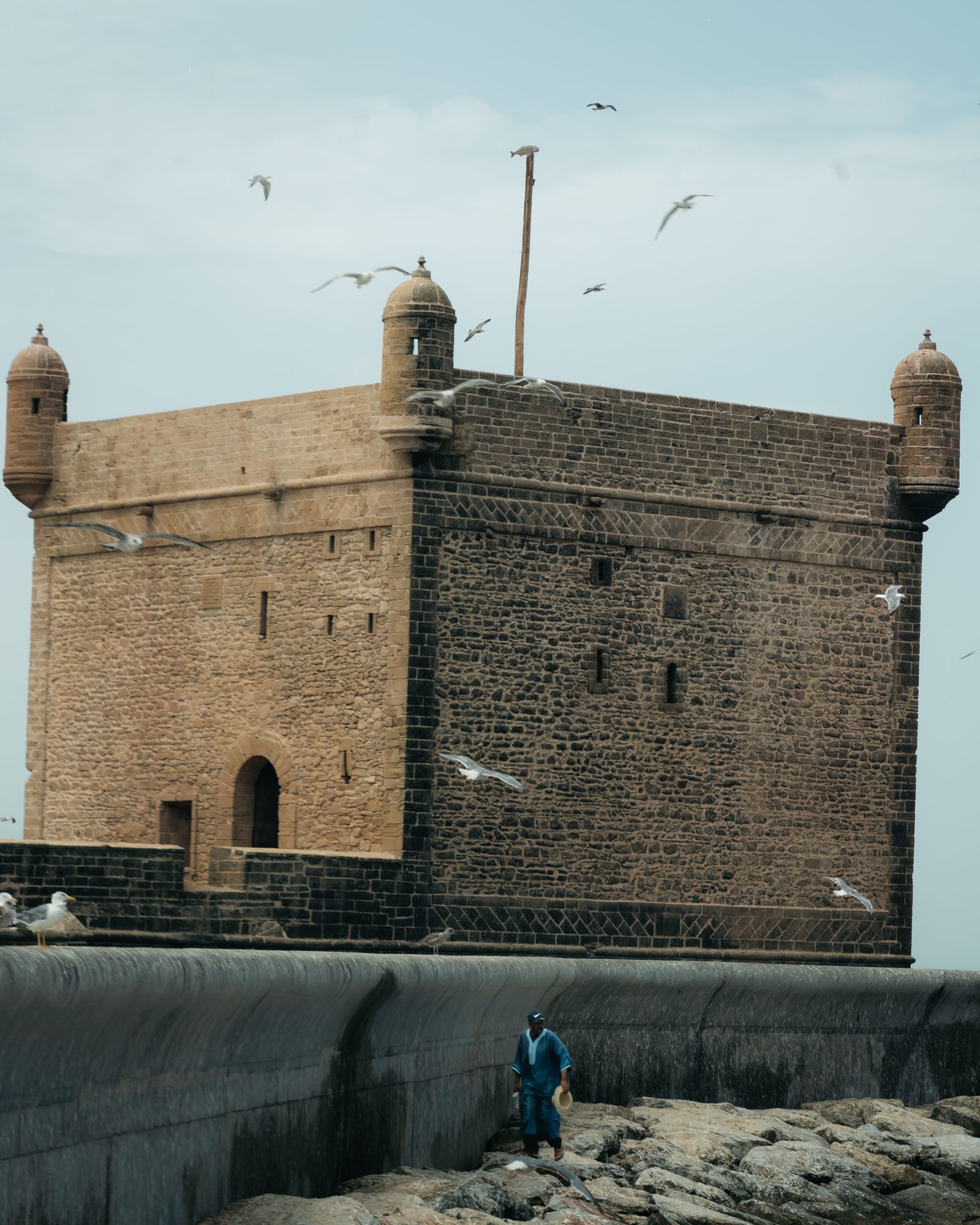
The sea walls (ramparts) of Essaouira are one of Morocco's great walks — a 2km circuit along the top of 18th-century fortifications, with bronze cannons pointing out to sea, seagulls wheeling overhead, and the Atlantic crashing against the base of the walls below. The most famous section is the Skala de la Ville (the sea bastion) — a platform bristling with Dutch cannons captured from a 17th-century warship. Entry: free. Walk it at sunset for extraordinary light on the ramparts and sea.
Below the ramparts, the working fishing harbour is one of the most atmospheric in Morocco. Blue-painted wooden boats pack the quays; fishermen repair nets and unload the morning catch; auction stalls sell fresh Atlantic fish by the kilo. Walk through the harbour at 8–10am when the boats return. You can buy directly from the boats (1kg sea bass: 60–80 MAD) and have it grilled immediately at the harbour-side restaurants for 20–30 MAD cooking fee. The freshest, cheapest seafood lunch in Morocco.
The Medina
Essaouira's medina is a UNESCO World Heritage Site with a character distinct from any other in Morocco. The streets are wide enough for two people to walk side by side without touching the walls — a French urban planning legacy that makes the medina feel open and navigable rather than labyrinthine. The blue-and-white colour scheme (white walls, blue window frames and doors, blue boats) is more muted and varied than Chefchaouen — not a single electric blue, but a range from pale sky to deep cobalt, faded by salt wind and sun.
The medina is known for its artisan workshops, particularly marquetry — the local wood inlay craft using thuya wood (a fragrant local timber with a distinctive burr grain) inlaid with lemon wood, ebony and mother of pearl. Essaouira is the world capital of thuya marquetry. A small decorative box costs 100–300 MAD; larger pieces (mirror frames, chess sets, furniture) 500–5,000 MAD. The quality varies enormously — examine the inlay closely before buying.
Gnawa Music
Essaouira is the world capital of Gnawa music — the West African spiritual and musical tradition brought to Morocco through trans-Saharan slavery that has evolved into one of the most distinctive musical forms in North Africa. The city has a large Gnawa community descended from enslaved West Africans, and the music permeates the city: from the guembri (3-string bass lute) rhythms drifting from workshops in the medina, to the performances in the evening at Place Moulay Hassan.
The Gnaoua World Music Festival takes place every June (check dates — it varies by year). For three days, the entire city becomes a music venue: multiple stages from the beachfront to the ramparts, a programme combining Gnawa masters with international jazz, blues and electronic artists, and free admission to all outdoor stages. Attendance regularly reaches 500,000 people over the three days — an extraordinary event that transforms quiet Essaouira into one of Africa's great music festivals.
Year-round Gnawa music can be heard at: Dar Gnawa (a dedicated Gnawa cultural centre in the medina, regular performances), and the small workshops and tea houses near the ramparts where Gnawa musicians practice and teach. The medina's guembri shops also function as informal jam venues — stop and listen whenever you hear the distinctive bass thump.
Water Sports
The consistent alizé winds make Essaouira one of the best kitesurfing and windsurfing destinations in Africa. The wind blows reliably from April to October; the beach south of the city (a 15-minute walk from the medina) is designated as a water sports zone with multiple schools offering lessons and rental.
- Kitesurfing lessons: 3-hour beginner session from 400–500 MAD. Most schools are clustered at the southern end of the beach (Km12 beach area). Equipment rental: 300 MAD/day for board + kite.
- Windsurfing lessons: 2-hour session from 300 MAD. The wide, flat beach section near the medina is better for beginners.
- Stand-up paddleboard: Rental from 150 MAD/hour on calmer days — the wind can make SUP challenging.
- Horse riding on the beach: The most atmospheric activity in Essaouira. 150–250 MAD/hour at sunset. Multiple stables operate from the beach near the city walls.
Day Trips
- Cap Sim — 15km south, a wild and deserted Atlantic headland with no facilities and extraordinary views. Grand taxi from Essaouira: 50 MAD each way. Walk the clifftop for 2 hours.
- Sidi Kaouki — 25km south, a remote surf beach with one restaurant and absolute silence. The most beautiful beach within day-trip range. Grand taxi: 80 MAD each way.
- Argan oil cooperatives — 20km inland on the road toward Marrakech, several women's cooperatives (including the famous Cooperative Marjana) welcome visitors to watch the hand-processing of argan nuts and buy pure oil directly. 30 MAD/100ml for certified cooperative oil vs 60–100 MAD at tourist shops.
- Marrakech day trip — 3 hours by CTM bus (70 MAD). Possible as a day trip but better as an overnight.
Where to Stay
- Les Terrasses d'Essaouira — Traditional riad in the medina with rooftop terrace. Excellent breakfast, friendly staff, central location. From 600 MAD/night.
- Madada Mogador — Design boutique hotel with sea-view rooms and one of the best rooftop restaurants in Essaouira. From 1,400 MAD/night. The sea-view suite (2,200 MAD) is worth the splurge for a honeymoon or special occasion.
- L'Heure Bleue — The grandest hotel in Essaouira — a palatial riad with pool, spa and rooftop cinema. From 2,500 MAD/night. Reserve far in advance for festival weeks.
Practical Guide
- Getting there: CTM bus from Marrakech (3 hours, 70 MAD, 4 daily departures). Supratours bus from Agadir (3.5 hours, 80 MAD). Grand taxi from Marrakech: 120–150 MAD per seat, 7–8 seats, departs when full.
- Best time: Spring (April–May) and autumn (September–October) for the best wind-sport conditions and comfortable temperatures. June for the Gnaoua Festival. Avoid August (very busy, accommodation prices triple).
- Wind advisory: The alizés blow hardest 2pm–6pm. Morning in Essaouira is often calm and beautiful. By 2pm the wind picks up significantly. Plan outdoor activities for morning or evening.
Related Articles
- Morocco Surf Guide: The Best Waves on the Atlantic Coast
- Argan Oil: Morocco's Liquid Gold — Where to Buy the Real Thing
- Gnawa Music: Morocco's Ancient Healing Tradition Explained
3 Perfect Days in Essaouira
17-page guide covering the ramparts, port seafood ordering protocol, Gnawa music scene, Atlantic day trips and the best surf-side riads.
Get it — $11.99 →