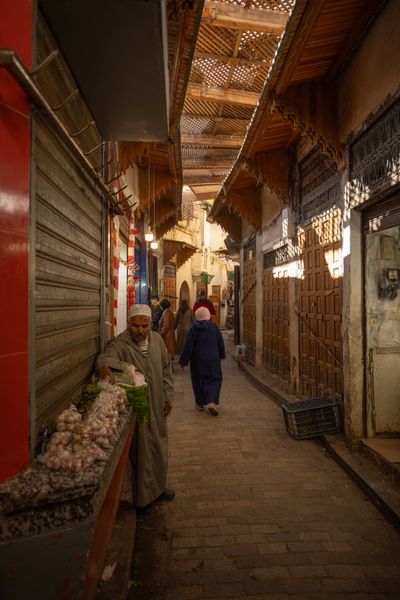
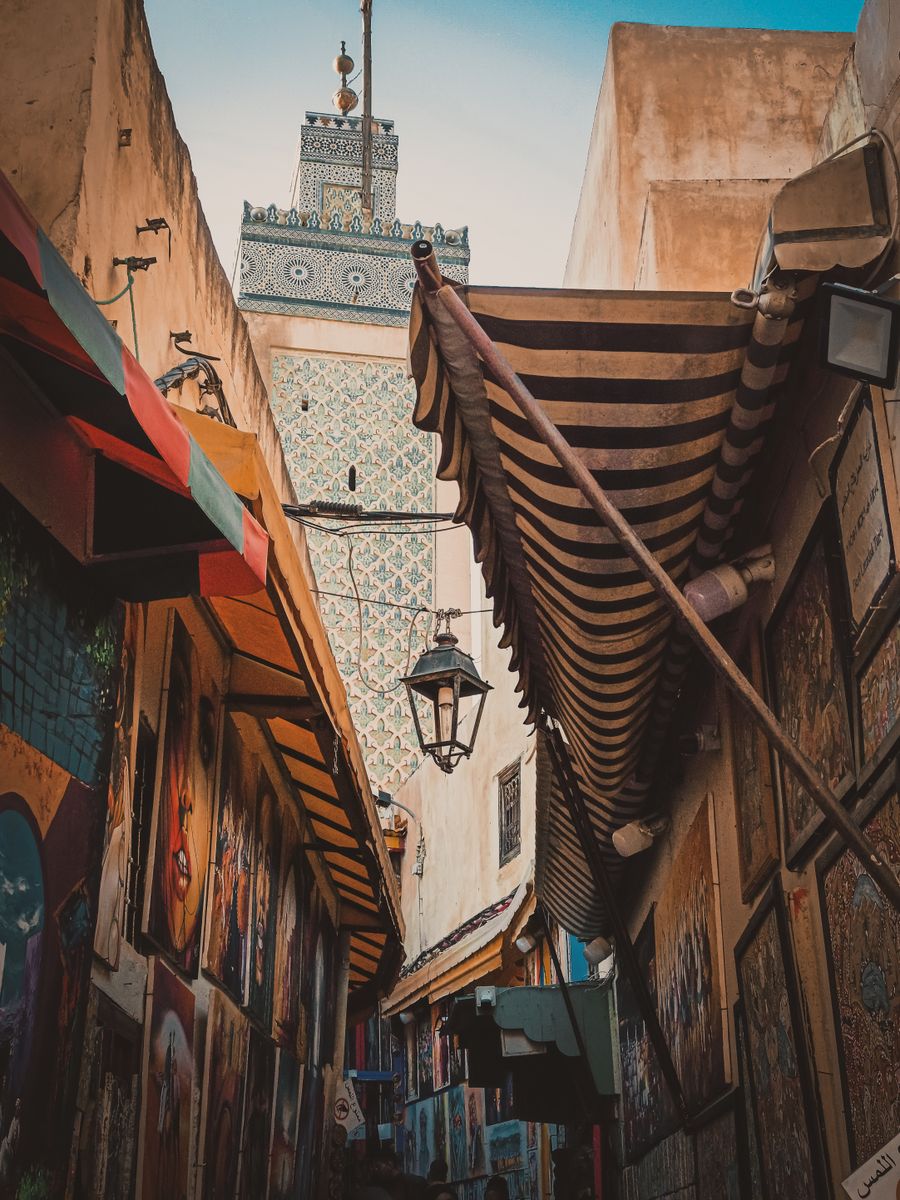
Fes el-Bali is the largest living medieval city on Earth. Founded in 789 AD by Idris I and expanded under his son Idris II, it covers approximately 280 hectares and contains an estimated 9,000 streets and alleys — the majority too narrow for a car, a bicycle, or even two people walking abreast. It is a UNESCO World Heritage Site, the spiritual capital of Morocco, and one of the most overwhelming places you will ever visit. This guide is designed to make that overwhelm feel like wonder.
Fes el-Bali: An Overview
The medina of Fes divides historically into two cities that grew together: Adouat Andalous (the Andalusian quarter, on the east bank of the Oued Fes river), settled by refugees from Córdoba in 817 AD, and Adouat Quaraouiyine (the Quaraouiyine quarter, on the west bank), settled by families from Kairouan, Tunisia, in 825 AD. A third zone, Fes el-Jdid (New Fes), was added in 1276 but sits just outside the main medina walls.
The Quaraouiyine quarter is the denser, more visited, and more disorienting of the two. It contains the Bou Inania Madrasa, the Chouara Tannery, the Quaraouiyine Mosque (founded 859 AD, home to what may be the world's oldest continuously operating university), and the great majority of Fes's souks and artisan workshops. The Andalusian quarter is quieter, less touristed, and rewards explorers willing to cross the river bridges.
Getting Oriented
Orientation in Fes el-Bali is genuinely difficult. Google Maps works but is often several years out of date regarding alley closures and new walls. The medina's topography — built across a hillside with the old city walls at top and the river at bottom — provides one reliable navigational anchor: walking downhill generally takes you toward the river and the Quaraouiyine Mosque; walking uphill takes you toward the city walls and the gates.
The Three Main Axes
Three named streets form the navigational spine of Fes el-Bali:
- Talaa Kebira (Grand Talaa): The widest commercial street, running downhill from Bab Boujeloud to the Quaraouiyine Mosque area. This is where you enter the medina and where you will keep returning as a reference point.
- Talaa Seghira (Small Talaa): Runs parallel to Talaa Kebira, slightly to the south. More residential, fewer souvenir shops.
- Derb Boutouil: The main route from the Quaraouiyine quarter to the Andalusian quarter, crossing the river via the R'cif bridge.
The Great Gates
Fes el-Bali is entered through a series of magnificent medieval gates (babs). The most important for visitors:
Bab Boujeloud
The main entry point and most photographed gate, built in 1913 during the French Protectorate to replace an older structure. Decorated with Moroccan zellige tiles in blue on the medina-facing side and green on the exterior (blue for Fes, green for Islam). All grand taxi and bus routes deposit visitors here. The restaurant terraces overlooking the gate are tourist-oriented but offer excellent views of arrivals and departures through the arch.
Bab Rcif
Located on the river, this gate marks the boundary between the Quaraouiyine and Andalusian quarters. The square in front — Place Rcif — is a local transport hub and a good place to find petit taxis for the return to Fes el-Jdid or the Ville Nouvelle.
Bab Guissa
The northern gate, reached by climbing through the potters' quarter. Spectacular views of the medina from the hillside above. The Merenid Tombs — 14th-century ruins offering the best panoramic view of Fes — sit a 10-minute walk beyond Bab Guissa.
Essential Monuments
Bou Inania Madrasa
The finest example of Merenid architecture in Morocco and the most accessible major monument in the medina (entry: 70 MAD). Built 1351-1357 by Sultan Abou Inan Fares, it served as both a theological college and, uniquely for a madrasa, a mosque. The interior is a masterpiece of Moroccan decorative arts: carved cedar wood screens above a band of carved plasterwork above zellige tilework, all surrounding a marble-paved courtyard with a central pool. The carved plasterwork panels are among the finest in the Islamic world — look for the interlocking geometric patterns that appear different from every angle. Students' cells on the upper floor are accessible and look out onto the courtyard. Open daily 9am-6pm; closed during prayer times.
Quaraouiyine Mosque
Founded in 859 AD by Fatima al-Fihri, a Tunisian woman whose father left her a fortune she used to build a mosque and attached school. The university established here is often cited as the world's oldest continuously operating university, predating Bologna (1088) and Oxford (c.1096-1167) by two centuries. The mosque can hold 20,000 worshippers and covers 3 hectares. Non-Muslims may not enter, but the decorated wooden doors facing onto several alleys allow glimpses of the prayer hall and courtyard. The best view of the central courtyard is from a rooftop café on Derb el-Cherabliyine, directly opposite an upper-level window.
Nejjarine Fountain and Museum
The Nejjarine (Carpenters') Square contains an ornate 18th-century public fountain (saqiya) decorated with glazed tiles and carved cedar — one of the most beautiful in Morocco. The caravanserai behind it has been converted into a woodworking museum (entry: 20 MAD) with displays of traditional tools and furniture. The rooftop café offers excellent views over the surrounding souk rooftops and is one of the few tourist-oriented spots that justifies its premium price (coffee: 25 MAD).
Attarine Madrasa
Adjacent to the Quaraouiyine Mosque, the Attarine Madrasa (entry: 20 MAD) was built in 1323 and is considered the most refined example of Merenid decorative work. Smaller than Bou Inania but arguably more delicate: the stucco lacework is so fine it resembles embroidery, and the carved cedar canopy above the central pool is extraordinary. Often quieter than Bou Inania despite being arguably superior.
The Tanneries
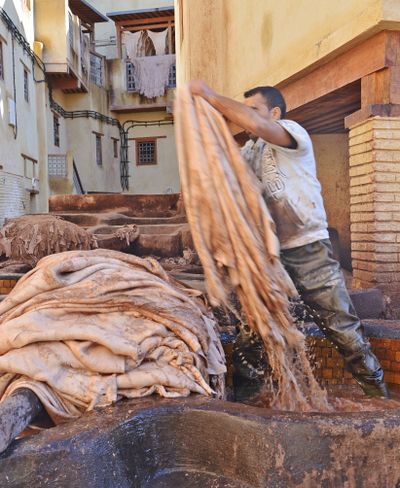
The Chouara Tannery — Fes's most famous sight — is located in the leather-workers' quarter near the Andalusian quarter border. See our dedicated guide to the Fes Tanneries for the full history, process, and photography tips. Key practical notes here:
- Viewing is free from leather shop terraces — no shop will turn you away, though you are expected to browse and may face pressure to buy
- The smell of the dyeing vats (particularly the pigeon-dung softening pools) is intense — accept the sprig of mint vendors offer at the terrace entrance
- Best light: morning (10am-12pm) when workers are most active and light fills the vat area from the east
- Second tannery: the Ain Azliten tannery near the Andalusian mosque is smaller, less visited, and offers an unobstructed street-level view without leather shops
Souk Districts
Unlike Marrakech's souks (which are clustered around a central market area), Fes's souks are distributed by craft throughout the medina, each guild historically occupying its own quarter. Walking from Bab Boujeloud down Talaa Kebira, you pass through them sequentially:
Souk Attarine (Spice Market)
Located between Bou Inania Madrasa and the Quaraouiyine Mosque, this is the most atmospheric and beautifully decorated souk in the medina, its stalls framed by carved wooden facades. Sells spices, herbs, essential oils, traditional cosmetics (kohl, beldi soap, ras el hanout). The smell — cumin, rose water, aged cedar — is intoxicating.
Souk Seffarine (Coppersmiths)
A small square near the Quaraouiyine where metalworkers hammer trays, teapots, and lanterns — the sound of hammering fills the air from 8am-6pm. This is the best place in Fes to buy copper and brass objects; prices are set (less haggling than other souks) and quality is high.
Souk Nejjarine (Carpenters)
The woodworking district surrounding the Nejjarine fountain. Artisans carve cedar, citron wood, and thuya using techniques unchanged since the Merenid era. Cedar tables, decorative panels, and thuya boxes make excellent purchases.
Souk Cherabliyine (Slipper-Makers)
The slipper (babouche) makers' quarter produces the yellow leather shoes that have become Morocco's most iconic souvenir. The best quality babouches in Morocco are widely considered to come from Fes — look for thick soles, hand-stitched seams, and proper leather lining (not synthetic). Prices: 80-250 MAD depending on quality.
Where to Eat
Clock Café
The most famous restaurant in the Fes medina, Clock Café occupies a beautifully restored riad opposite the Tala'a Kebira. Best known for its camel burger (65 MAD — a legitimate innovation, not a gimmick), the menu also covers excellent vegetarian options, Moroccan breakfast platters (40 MAD), and superb fresh juices. The roof terrace has views over medina rooftops. Also runs cooking classes and cultural events; check the noticeboard.
Restaurant Nur
Set in a 17th-century riad near the Nejjarine fountain, Nur offers the most refined Fassi cuisine in the medina. Chef Najat Kaanache — the first Moroccan woman to hold a Michelin star (at a restaurant in San Sebastián) — has created a menu that treats traditional recipes as fine dining: bastilla with almond and pigeon, preserved lemon chicken with pickled rose petals, orange-flower water crème caramel. Lunch set menu: 220 MAD. Dinner: 350-500 MAD. Reservations essential.
Riad Rcif Terrace
For the classic medina experience — tagine on a rooftop with views over ancient rooftops — the terrace at Riad Rcif near Place Rcif is reliably good. Chicken and preserved lemon tagine: 75 MAD. Harira: 15 MAD. Briouat (fried pastry triangles): 20 MAD for six. Tourist-oriented but fair prices and genuine food.
Street Food: L'Hôtel de Ville Area
The evening street food concentration near the old city hall building on Talaa Kebira: smen-fried msemen flatbreads (8 MAD), battered fish (15 MAD), bissara (split pea soup, 10 MAD). This is where medina residents eat — quality is high and prices are honest.
On Guides
The question of whether to hire a guide in Fes is more complex than any other Moroccan city. The medina is genuinely confusing enough that a knowledgeable guide adds real value — particularly for first-time visitors. However, the guide industry in Fes has a reputation for commission-heavy practices: guides direct visitors to shops where they earn commissions ranging from 30-50% of your purchase price, inflating costs accordingly.
Options
- Official guides: Licenced by the Ministry of Tourism (identifiable by a badge). Rates: half-day 150-250 MAD, full day 300-450 MAD. Book through your riad or the tourist office near Bab Boujeloud. Ask explicitly at the outset that you prefer not to visit shops — a good guide will respect this.
- Riad guides: Many riads employ excellent local guides (often young men who grew up in the medina) for guests. These tend to be more culturally sensitive and less commission-oriented than street guides.
- Self-guided with map: Download the Fes medina layer on Maps.me (more complete than Google Maps for alleys). Accept that you will get lost. Embrace this: the best discoveries in Fes happen when you stop looking for the Quaraouiyine and find instead a neighbourhood hammam, a madrasa courtyard left unlocked, or a family's jasmine-draped alleyway.
Practical Tips
When to Visit
Fes is a year-round destination, but spring (March-May) and autumn (September-November) offer the most comfortable temperatures for walking the medina (18-24°C). Summer temperatures exceed 35°C in July-August — still manageable in the shaded alleys but exhausting. The medina is quieter on weekday mornings; busiest on Saturday afternoons when Moroccan day-trippers arrive from Casablanca and Rabat.
What to Wear
Comfortable walking shoes with good grip — the medina streets are uneven stone, often slippery when wet. Cover shoulders and knees out of respect; this is a living religious community, not a museum. A light scarf is useful for women in the tannery area (the smell) and in conservative residential quarters.
Staying in the Medina
Riads within the medina offer the most atmospheric accommodation but require dragging luggage through narrow alleys. Most will arrange porterage from Bab Boujeloud (50-80 MAD). Budget options cluster near Talaa Kebira; boutique riads are found throughout but concentrate in the quieter back alleys off the main souk routes. Expect to pay 300-500 MAD for a decent double in a mid-range riad.
Day Trip from Elsewhere?
Fes is frequently visited as a day trip from Rabat (2h by train) or Casablanca (3h30). This is possible but unsatisfying — the medina rewards time. If you can only spare one day, arrive on the first train from Rabat, spend 6 hours in the medina with Bou Inania Madrasa and the tanneries as anchors, eat at Clock Café, and catch the 5pm train back. Two nights minimum is far better.