In This Article
In Morocco, you will be offered mint tea approximately forty-seven times per day. In carpet shops, in riad courtyards, in the homes of strangers who insist you come in out of the heat, in spice souks, in taxi offices, in the waiting rooms of government buildings. The tea is not always excellent. But the offer is always genuine — a signal that you are welcomed, that time will be made for you, that hospitality is not a performance but an obligation of character.
Understanding the Moroccan mint tea ritual is not just pleasant background knowledge. It is one of the keys to travelling Morocco well. Knowing when to accept, how to hold the glass, what the foam means, and when the tea is actually being used as a sales technique — all of this makes every cup more meaningful.
The Three Pours
The most famous saying about Moroccan mint tea describes the three servings that tradition calls for:
"The first glass is as gentle as life. The second is as strong as love. The third is as bitter as death."
In practice, all three pours come from the same pot and the flavour difference is subtle — the first pour is the most dilute, the third has more concentrated mint and tannin. But the symbolism matters. Three glasses is the minimum complete offering. Accepting only one is fine; accepting all three is the polite choice when time allows.
The pour itself is an art. The server holds the teapot 30–40 centimetres above the glass and pours in a high, thin arc. This aerates the tea and creates a foam on the surface. The foam — rozza — is considered a mark of quality. A skilled server can produce a consistent, fine-bubbled foam that holds for several minutes. No foam means the pour was too low or the tea too cold.
History of Tea in Morocco
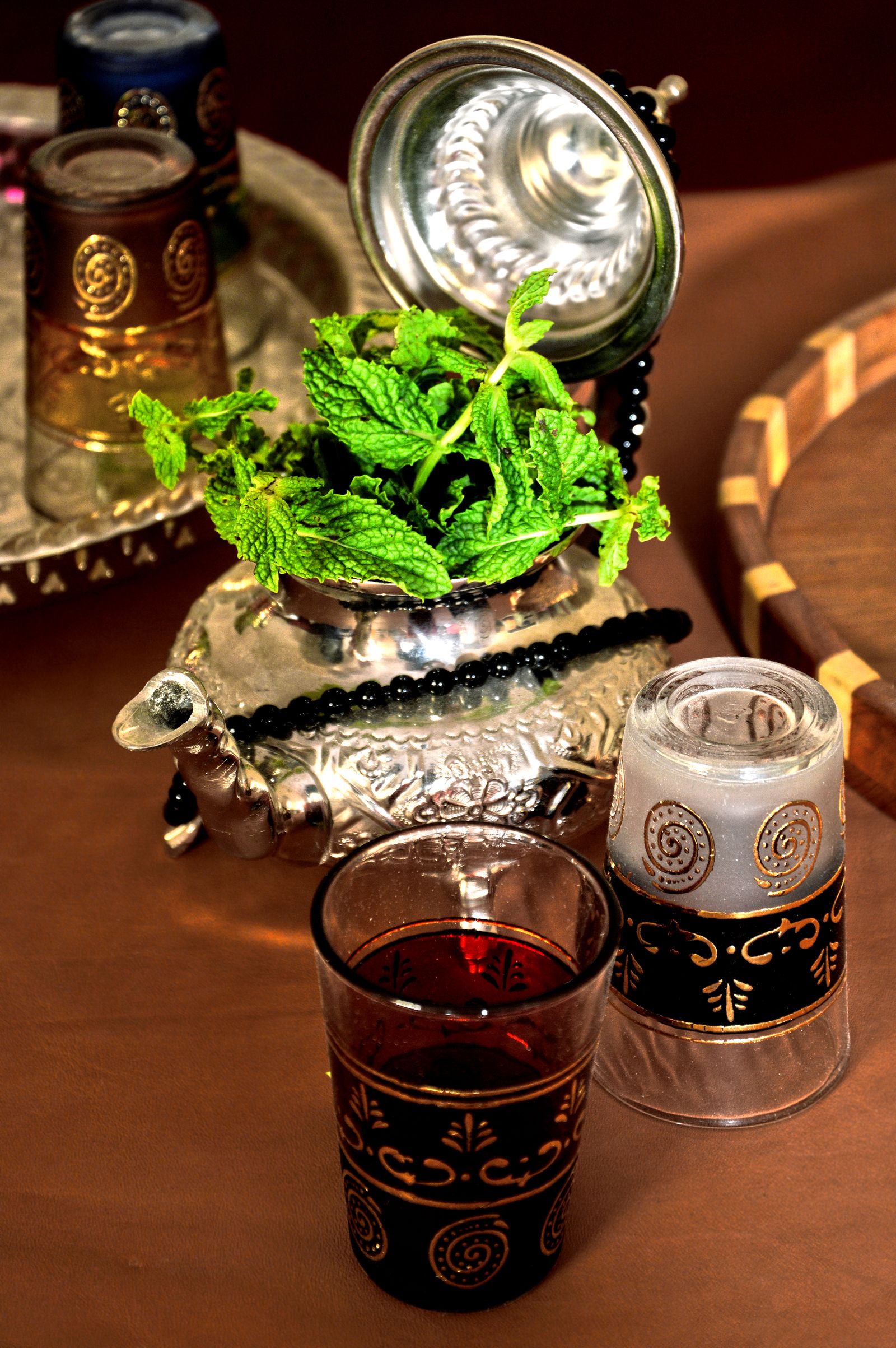
Tea is not native to Morocco, and its dominance in Moroccan culture is surprisingly recent. Green tea arrived in Morocco in 1854, introduced by British merchants who were blocked from their usual Baltic markets during the Crimean War and sought new outlets for their Chinese gunpowder green tea surplus. Moroccan merchants, particularly in the northern port city of Mogador (now Essaouira), acquired the tea and discovered that it combined beautifully with the fresh spearmint (nana) that grew abundantly in Moroccan gardens.
Within a generation, mint tea had become the national drink. It spread from the merchant class to every level of Moroccan society, from the Atlantic coast to the Saharan south. The silver teapot (berrad) and ornate painted tea glasses became essential household objects. By the early 20th century, Morocco's mint tea culture was as deeply established as if it had existed for a thousand years.
The Ceremony
Making Moroccan tea correctly is a deliberate, unhurried process. It is not instant tea — it is a small ceremony that takes 10–15 minutes from start to first glass.
- Warm the pot — Hot water is poured into the silver teapot to warm it, then discarded.
- First steep — Gunpowder green tea is added and a small amount of boiling water poured in. The pot is swirled and this "washing" water is discarded — it removes bitterness and excess tannin from the first steep.
- Second steep with mint and sugar — Fresh mint and sugar are added, then a full measure of boiling water. The pot sits on low heat for 2–3 minutes.
- The mixing pour — Tea is poured into a glass and poured back into the pot — once or twice — to mix the sugar evenly.
- The serving pour — Tea is poured from height into small glasses, producing the characteristic foam.
Types of Moroccan Tea
While the classic spearmint preparation dominates, Morocco has a rich variety of tea traditions that vary by region and season:
- Atay b'nana — Classic spearmint tea. The standard everywhere.
- Atay b'louiza — Vervain (lemon verbena) tea. Lighter, more floral, popular in summer.
- Atay b'chiba — Wormwood tea. Intensely aromatic, slightly bitter, common in the southern regions. An acquired taste.
- Atay beldi — "Country tea" — sometimes means tea without mint, sometimes means a wild herb blend depending on the region.
- Atay b'zaatar — Thyme tea, popular in the Rif Mountains and north.
- Rose water tea — Occasionally served at luxury riads as a welcome drink. Delicate and fragrant.
Etiquette for Visitors
- Never refuse tea from a host — Refusing tea offered in a private home or as a gesture of hospitality is genuinely rude. Even if you've had six cups already, accept the glass and take a few sips.
- In a shop, it's more nuanced — Tea offered in a carpet shop or souk stall is hospitality, but it does come with an implicit social contract. If you accept tea, stay for the conversation. If you're not interested in buying anything, it's kinder to decline the tea rather than drink it and leave immediately.
- Use two hands — When receiving a glass of tea, use both hands or your right hand. The left hand is considered unclean in Moroccan custom.
- Sweetness adjustment — If you prefer less sugar, say "shwiya sukkar" (a little sugar) before the tea is made. Asking to reduce sugar after it's prepared is impractical.
- Three glasses is sufficient — It is perfectly acceptable to decline a fourth glass by placing your hand over the glass. This signals "enough" politely.
Where to Drink the Best Tea
- Djemaa el-Fna terrace cafés, Marrakech — At sunset, with the square transforming below you. Tea costs 15–20 MAD. The view is worth ten times that.
- Café des Épices, Marrakech — On Rahba Kedima square. The rooftop terrace overlooks the spice market. Consistently good tea, 20 MAD.
- Plaza Uta el-Hammam, Chefchaouen — The cafés around the main square serve tea alongside fresh msemen and honey. The blue walls, the mountain air, the mint — perfect.
- Café Clock, Fes and Marrakech — More touristic but genuinely good. Their Moroccan tea is properly made. 20 MAD.
- Any riad breakfast table — The unhurried morning pot at a good riad, poured over the courtyard, is simply the best possible context for Moroccan tea.
Making It at Home
A proper at-home setup requires: Chinese gunpowder green tea (widely available online), fresh spearmint (not dried), a silver or stainless teapot with a curved spout, small tea glasses, and a sugar cone or loose sugar cubes. The ratio: 1 teaspoon gunpowder tea per 400ml water, a generous handful of fresh mint, 3–4 sugar cubes per small pot (adjust to taste).
The most common mistake Westerners make is using dried mint or tea bags. The result is technically tea but it is emphatically not Moroccan mint tea. Fresh spearmint is non-negotiable — it is sold in bunches in most supermarkets. Buy more than you think you need.