In This Article
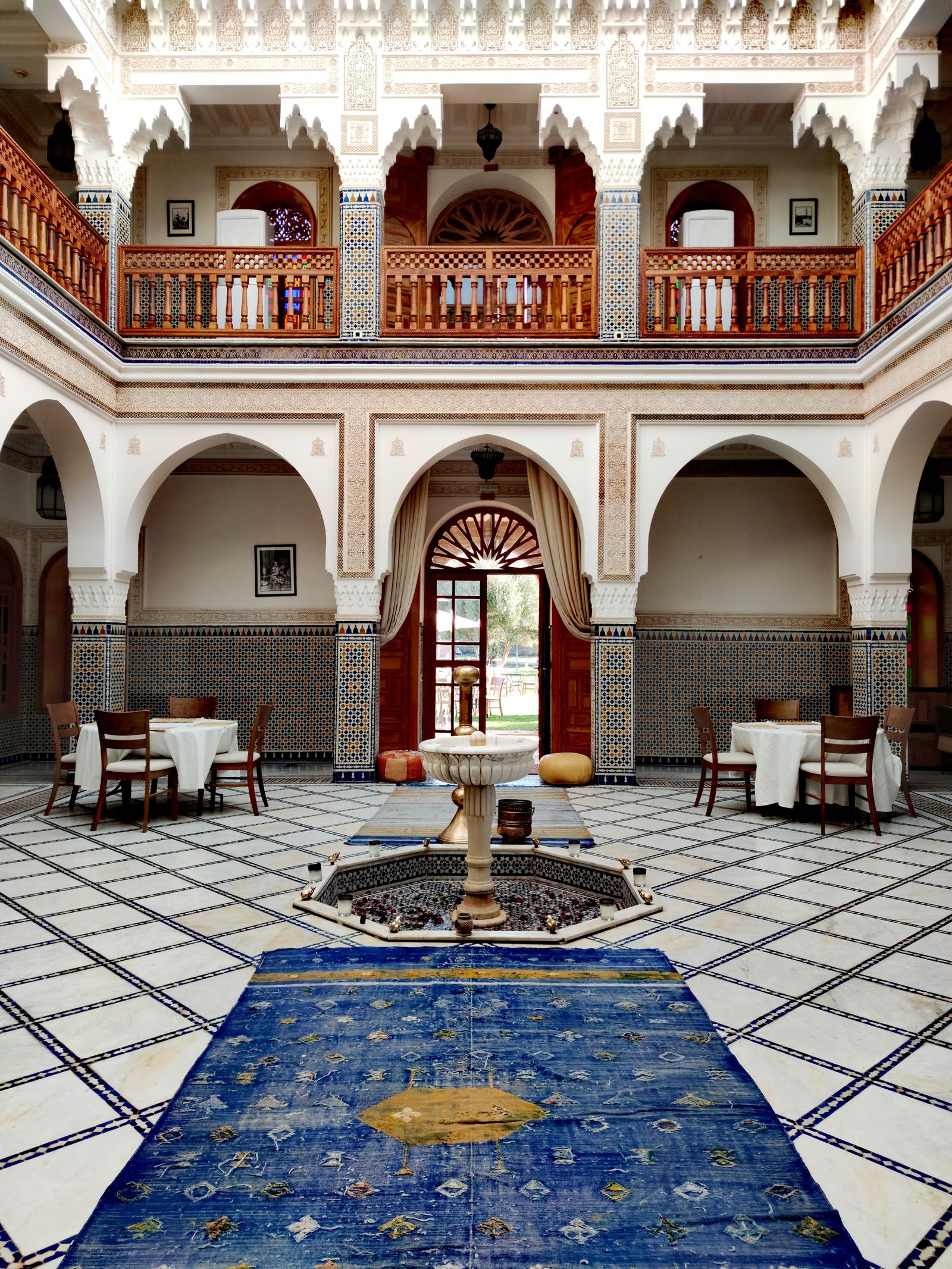
The riad is Morocco's greatest gift to the traveller who wants more than a hotel room. From the outside, a riad is nothing — a blank wall, a heavy wooden door, perhaps a brass knocker. Push that door open and you step into another world: a courtyard garden with a central fountain, zellige-tiled walls rising three storeys around you, carved cedarwood ceilings overhead, the scent of orange blossom and rose water, and absolute silence despite being five minutes from the noisiest souk in Africa.
This guide will help you understand what a riad actually is, what distinguishes a great one from a disappointing one, and how to book without being misled by beautiful photography that hides a mediocre location or a damp ceiling.
What Is a Riad
The word riad comes from the Arabic rawdha, meaning garden or paradise. A riad is a traditional Moroccan townhouse built around a central courtyard — the opposite of a Western house, which faces outward. All the rooms face inward toward the courtyard. There are typically no windows on the exterior walls. The world is shut out; the world inside is curated and peaceful.
Riads were built this way for very good reasons. The high exterior walls keep summer heat out and winter cold in — the thick clay walls act as natural insulation. The central courtyard creates a microclimate: cooler in summer, warmer in winter. The garden (often with a central fountain, orange or lemon trees, rose bushes) humidifies the air naturally. And the inward orientation provided privacy in dense urban medinas where houses were built wall-to-wall.
Traditionally, riads were family homes for wealthy Moroccan merchants, scholars and officials. Many were abandoned during the French colonial period (1912–1956) when affluent Moroccans moved to the new European-style villes nouvelles. In the 1990s and 2000s, European buyers — particularly French and British — began purchasing and restoring abandoned riads in Marrakech, Fes and Chefchaouen, converting them into guesthouses. This sparked the riad tourism boom that defines Moroccan hospitality today.
Riad vs. Hotel
A riad is not a hotel, and expecting hotel-like service from a riad leads to disappointment. A riad is a private home that happens to take guests. This brings both advantages and limitations.
For most visitors who want to genuinely experience Morocco — especially in Marrakech and Fes — a riad in the medina is vastly preferable to a hotel outside it. The medina is the experience. Staying inside it puts you ten minutes from everything.
How to Navigate Booking
Riads are bookable on the usual platforms (Booking.com, Airbnb, direct websites) but require more careful research than a standard hotel. A 4-star hotel in Marrakech has standardised expectations; a riad has idiosyncratic strengths and weaknesses that only recent reviews will reveal.
Read reviews from the last six months only — riads change ownership and standards can shift dramatically. Look for mentions of: the breakfast (quality is a reliable indicator of overall hospitality), the meet-and-greet service (how they escort you to the riad from a taxi drop point), and the wifi speed (relevant if you're working).
What to Look For
- Rooftop terrace — Essential. A riad without a rooftop terrace loses half its appeal. The rooftop is where you have breakfast, watch the sunset, and escape the medina noise at eye level with the minarets.
- Meet-and-greet service — Riads deep in the medina are genuinely hard to find on a first visit, especially at night. A good riad will send someone to meet you at a recognisable landmark (usually a nearby gate or mosque) and escort you in. This is not a luxury extra — it is essential hospitality. If it's not mentioned on the website, ask.
- Location description — A riad deep in the medina (harder to access, more authentic, quieter) is different from one near the main gates (easier access, more tourist activity nearby). Neither is better, but know which you're choosing.
- Courtyard fountain or plunge pool — In summer, a plunge pool is enormously valuable. A dry courtyard with no water feature can feel oppressive in July heat.
- Recent reviews from solo women — A reliable indicator of safety, hospitality standards and how well the riad handles guests traveling alone.
Red Flags
Best Riad Cities
- Marrakech — The most riad choice anywhere in Morocco. Several hundred operational riads across every price point. The medina is large but navigable. Best for first-time riad stays.
- Fes — The most authentic riad experience. Fes el-Bali is genuinely medieval and the riads here feel like stepping into a living history. More traditional, fewer amenities, more atmosphere.
- Chefchaouen — The best value riad experience in Morocco. Small medina, relaxed atmosphere, lower prices. Limited choice but consistently high quality at the mid-range level.
- Essaouira — Boutique riads with an artistic, windswept Atlantic character. Fewer options but very pleasant.