In This Article
I arrived with a return ticket for 7 days. I cancelled it on day 3. Dakhla does that to people.
At the southern tip of a narrow peninsula jutting into the Atlantic, 1,700km south of Casablanca and 600km north of Mauritania, Dakhla is one of the most improbable destinations on earth — and one of the most extraordinary water sports locations anywhere. A flat lagoon, consistent trade winds, flamingos in the shallows, and some of the freshest seafood you'll ever eat. I stayed a month.
Why Dakhla? The Numbers Don't Lie
The global kite community has ranked Dakhla as one of the world's top three kitesurfing destinations for over a decade, alongside Tarifa (Spain) and Cabarete (Dominican Republic). But Dakhla has something neither of those locations offers: a massive, shallow, flat-water lagoon that works at almost any skill level.
In Tarifa, you're fighting Atlantic swell. In Cabarete, the reef is unforgiving. In Dakhla, the lagoon is ankle-to-waist deep, the bottom is sand, and the trade winds are so consistent and so predictable that the Dakhla Kite World Cup has been held here for 15 consecutive years. Professionals come to train their freestyle. Beginners come to learn. Everyone progresses faster here than anywhere else.
The Lagoon — What It's Actually Like
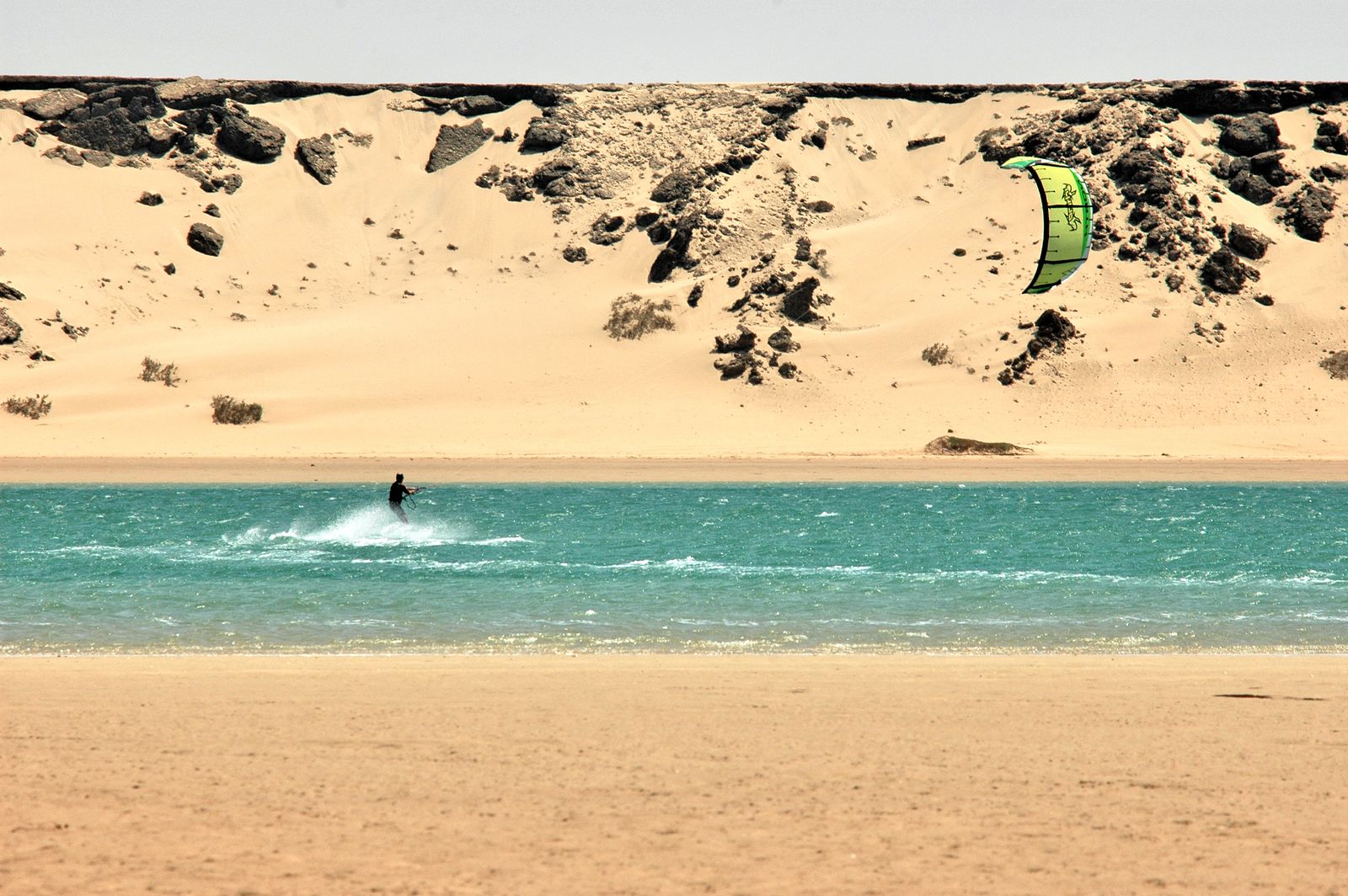
The Dakhla lagoon is not a bay. It is a protected body of Atlantic water enclosed by the peninsula on one side and a sand barrier on the other, 40km long, rarely more than 1m deep, with a sandy bottom that you can walk on for hundreds of metres. The colour ranges from pale turquoise in the shallows to deep teal at the channel. From above it looks like a frame from a Caribbean tourism advert.
The winds enter from the north, side-onshore to the main kite beach, which means mistakes send you up the lagoon rather than out to sea. This is the critical safety factor that makes Dakhla excellent for beginners — there is essentially no danger of being blown out to open ocean.
In the shallows at the lagoon's southern end, a colony of pink flamingos wades through the water at dawn. They are visible from the kite spots and sometimes, improbably, through the spray of a passing kiter. It remains one of the most surreal images I have encountered in ten years of water sports travel.
Wind & Weather — Month by Month
| Month | Wind Strength | Consistency | Air Temp | Best For |
|---|---|---|---|---|
| Jan–Feb | 20–28 kts | ★★★★☆ | 18–22°C | Advanced freestyle |
| Mar–Apr | 22–30 kts | ★★★★★ | 20–24°C | All levels |
| May–Jun | 25–35 kts | ★★★★★ | 22–26°C | Advanced, foiling |
| Jul–Aug | 25–35 kts | ★★★★★ | 24–28°C | All levels — peak season |
| Sep–Oct | 22–30 kts | ★★★★★ | 22–26°C | All levels — best months |
| Nov–Dec | 18–25 kts | ★★★★☆ | 18–22°C | Lighter wind freestyle |
The Kite Spots
🪁 The Main Lagoon (Dunes du Pacifique)
The primary kite spot, in front of most of the camps. Flat water, sand bottom, consistent north winds. Shallow enough to walk to the kite zone from the beach. Beginner paradise. Gets crowded in peak months — arrive early.
🪁 Speed Strip
A narrow corridor of super-flat water between two sand banks, used for speed record attempts. The surface is so smooth that riders regularly exceed 40 knots. Not for beginners — watch from the bank first.
🪁 Lassarga (Ocean Side)
For wave riders only. The Atlantic swell hits the outside of the peninsula with proper surf — head-high to overhead sets on good days. Requires intermediate-to-advanced level and experience reading ocean conditions.
🪁 The Pink Lake (Lac Rose)
A shallow salt lake north of town that turns pink in high summer due to algae. Wind is lighter here, perfect for beginners and foil board riders. Surreal backdrop for photos.
Kite Camps & Schools
Dakhla has around 15 established kite camps ranging from budget backpacker to boutique luxury. They cluster along the lagoon road north of town.
- Dakhla Attitude — The longest-established and most professional camp. IKO-certified instructors, full equipment rental, accommodation from dorms to private bungalows. Lessons from 600 MAD/hour.
- Dakhla Kite Paradise — Smaller, more personal atmosphere. Excellent for solo travellers. Good restaurant with fresh fish from the port daily.
- Ocean Vagabond — Best food of any camp. Also offers SUP, wingfoil, and surf lessons. Strong community vibe — people stay for weeks.
- Calema Windsurf & Kite — The windsurf specialist. If you want both disciplines, this is the camp.
Lesson Costs (2026)
- IKO Level 1 beginner course (8 hours): 2,400–3,000 MAD (~$240–300)
- Equipment rental (full day): 400–600 MAD
- Private 1-hour lesson: 600–800 MAD
Living in Dakhla Long-Term
The digital nomad-kiter hybrid has discovered Dakhla in force over the last five years. The numbers make sense:
- Apartments: Studio apartments from 2,500 MAD/month ($250), 1-bedroom from 3,500 MAD ($350). Most near the lagoon include a terrace.
- Food: Fresh lobster at the port market for 60–80 MAD/kg. Fish soup at local restaurants for 20 MAD. Coffee at a corner café, 5 MAD.
- Internet: 4G coverage is solid across the town and most camps. Several cafés and all camps offer Wi-Fi. Coworking space opened in 2024.
- Community: Dakhla's permanent kite expat community is tight, multilingual (French, Spanish, German, English), and extremely welcoming. The WhatsApp groups for the daily wind forecast are how you'll know when it's on.
Beyond Kitesurfing
Dakhla is not just for kiters. The broader adventure offering includes:
- Sandboarding on the Atlantic-facing dunes south of town — massive, fast, and empty
- Quad biking in the desert interior — 2-hour routes through hamada and fossilised beaches
- Fishing trips with local fishermen from the port — dawn departures, catch-and-eat on return
- Flamingo kayak tours — paddling through the southern lagoon shallows at dawn with the flamingo colony
- Surf day trips to undiscovered Atlantic breaks south of town
Getting There
- By air: Royal Air Maroc flies Casablanca → Dakhla (DIP) daily, ~2.5 hours. Book ahead — the 28-seat turboprops fill fast in peak season.
- By road: The N1 coastal highway from Agadir runs 1,100km to Dakhla, almost entirely through Atlantic desert. 2-day drive. Spectacular and almost completely empty.
- From the south: Possible entry from Mauritania via the Guerguerat border crossing, but requires advance preparation — check current conditions.
The Atlantic Coast Beyond the Lagoon
Most kite visitors never leave the lagoon zone. The Atlantic coast directly west of Dakhla — accessed by driving over the spine of the peninsula — is one of the most dramatic landscapes in West Africa. Towering red cliffs drop directly into the Atlantic swell, backed by sand dunes that extend inland for kilometres. There is nobody there. In February and March, flamingos feed in the shallow coastal inlets 30km north of the city, and migratory birds stop along the entire coast on their way between Europe and sub-Saharan Africa.
Driving the peninsula's ocean-facing coast requires a car and ideally a 4WD for the sandy tracks. The paved road runs as far as the Dunes du Pacifique camp turnoff; beyond that it's piste. Follow any track heading west and you'll reach the ocean within 10 minutes. Take food, water, and a full fuel tank. Mobile signal disappears behind the dunes.
Dakhla Beyond Kitesurfing — The City Itself
Dakhla city is frequently overlooked by kite visitors who spend their entire trip at the lagoon camps. This is a mistake. The city of 120,000 people reflects a genuinely distinct identity — Sahrawi culture, Hassaniya Arabic dialect, an architecture shaped by the Spanish colonial period and then the Moroccan administration after 1976. The main market has goods you won't find in northern Morocco: Mauritanian silver jewellery, camel leather, traditional Sahrawi dress (the daraa robe).
The Thursday souk (weekly market) is the best day to visit the city — vendors from across the region arrive with produce, livestock, and craft goods. The fish market at the port (daily, 7–10am) is extraordinary — fresh lobster, crab, and shellfish sold for a fraction of what they'd cost in Agadir or Casablanca. Take a taxi from your camp; it costs 80–100 MAD each way and the morning light on the bay is worth the early wake-up.
How to Get Here & What to Know
Dakhla is 1,200km south of Agadir — roughly equivalent to driving from London to Barcelona. This is both its appeal and its challenge. The fastest practical option is flying (RAM from Casablanca, ~2.5h, 500–900 MAD one-way). For those with time and adventure appetite, the N1 coastal road south from Agadir is one of the finest drives in Africa: empty Atlantic beaches, Saharan hamada stretching to the horizon, the occasional camel, and fuel stations that require planning.
Within Dakhla, book accommodation at one of the established lagoon camps rather than in the city if kitesurfing is your goal — the transfer costs and daily commute from city hotels eat into your session time. Camp packages (typically Sunday–Sunday, all-inclusive) are the most efficient structure. Solo travellers can join existing camp groups; the kite community is international and welcoming.