In This Article
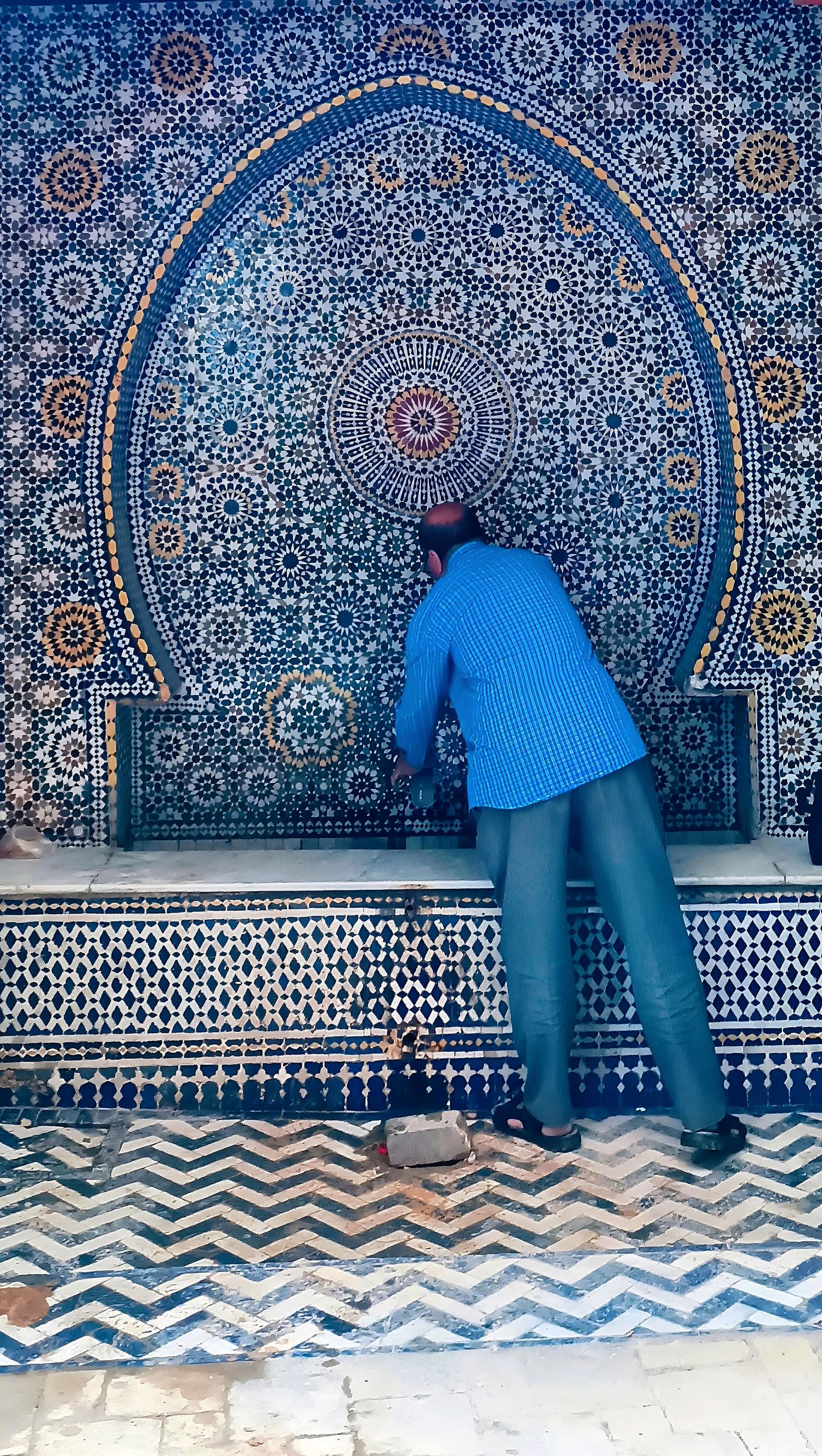
Walk into any palace, madrasa, or grand riad in Morocco and your eyes will immediately drop to the lower walls — and stay there. Zellige tilework is one of the most visually arresting art forms in the world: geometric patterns so intricate they seem impossible, colours so deep they glow, a mathematical precision that rewards the longer you look. It is also one of the most labour-intensive crafts on earth.
Zellige (pronounced "zuh-LEEJ") is not merely decoration. It is a complete artistic, spiritual and technical tradition that encodes Islamic mathematics, theology and cosmology into every panel. Understanding how it's made — and why it looks the way it does — transforms a beautiful wall into something genuinely profound.
What Is Zellige
Zellige is hand-cut terracotta tile coated with an enamel glaze, then hand-chiselled into precise geometric shapes and assembled face-down in complex mosaic patterns. The final panel is grouted, flipped, and installed on walls, floors, fountains and columns.
What distinguishes zellige from other mosaic traditions is the combination of three things: the irregular, handmade nature of each tile (giving it a depth and warmth that machine-cut tile cannot replicate); the extraordinary geometric complexity of the patterns; and the all-natural enamel glazes that produce colours of exceptional richness.
A 1,000-Year History
Zellige originated in Fes in the 10th century, during the Idrisid dynasty that established Fes as the spiritual and cultural capital of Morocco. The earliest examples were relatively simple geometric borders. By the Marinid dynasty (13th–15th centuries) — the great age of Moroccan Islamic architecture — zellige had evolved into the extraordinarily complex full-wall panels you see today at the Ben Youssef Madrasa in Marrakech and the Bou Inania Madrasa in Fes.
The Marinids were extraordinary patrons of the arts and architecture. Their buildings — madrasas, mosques, palaces — were designed as complete artistic statements in which zellige, carved stucco, and cedarwood calligraphy were combined into harmonious wholes. The craftsmen who produced this work were organised into guilds (hmada) in Fes, and much of Morocco's surviving zellige tradition traces directly back to those Fes workshops.
The tradition survived the upheavals of the Portuguese incursions, the Sa'adian period, the Alaouite dynasty, French colonialism and modern development — a remarkable continuity. Today Fes remains the unquestioned capital of zellige production. The workshops of the Fes el-Bali medina continue to supply zellige to palaces, mosques, riads and interior designers worldwide.
How It's Made
The production of zellige involves six stages, each requiring distinct skills. A single master craftsman (maalem) oversees the work, but teams of specialists handle different stages.
- Clay preparation — Local red clay from the Fes region is mixed, kneaded and rolled into uniform slabs approximately 1.5cm thick.
- Moulding — The slabs are pressed into moulds to create flat square tiles (typically 10×10cm to 15×15cm). The surface is smoothed to a perfectly flat finish — critical for the final assembly.
- First firing — Tiles are fired in a wood-burning kiln at around 900°C for the initial bisque firing. This produces an unglazed terracotta tile.
- Glazing — The tile surface is coated with powdered mineral oxides suspended in a silica-rich glaze. Each colour requires a separate glaze formulation: cobalt for blue, copper for green, manganese for black, antimony for yellow, iron for red. The tile is fired again at 1,000°C to fuse the glaze.
- Hand-chiselling — This is where the magic happens. A maalem places the fired glazed tile face-down on a sand-filled sack and uses a short-handled chisel (menjour) to strike precise cuts, shaping the tile into one of 360 recognised geometric shapes. The cutting is done freehand, guided entirely by training and experience. A single mis-strike can shatter the tile. This stage takes years to master.
- Assembly — The cut shapes are laid face-down on a paper template of the design and fitted together like a jigsaw puzzle. The seams are filled with lime mortar from behind. When the mortar sets, the panel is flipped and installed.
The Geometry Behind the Art
Zellige patterns are not arbitrary decoration. They are the visual expression of Islamic geometry — a mathematical and theological tradition that understands geometric patterns as a meditation on the infinite nature of God.
Islamic art prohibits figurative representation of the divine or of human forms (in religious contexts). Instead, Islamic artists developed geometric abstraction to its highest possible expression. The infinite repeatability of geometric patterns — a pattern that could theoretically continue forever in every direction — symbolises the infinite nature of Allah. Standing before a zellige wall, you are looking at a meditation on the divine expressed in mathematics.
The primary geometric units in zellige are based on combinations of triangles, squares, hexagons, octagons and twelve-pointed stars. The most complex patterns involve 32-fold symmetry — mathematical structures that were understood by Moroccan craftsmen centuries before Western mathematics formalised them. The patterns visible in Marinid-era buildings represent some of the most sophisticated geometric thinking in human history.
Where to See the Best Zellige
Morocco has extraordinary zellige in easily accessible locations. These are the unmissable examples:
- Hassan II Mosque, Casablanca — The world's third-largest mosque (completed 1993) contains the most extensive zellige interior in the world. The floors and lower walls are covered in over 50,000 square metres of zellige. Non-Muslim visitors can enter on guided tours (130 MAD, three times daily). Unmissable.
- Ben Youssef Madrasa, Marrakech — The finest surviving Marinid-era zellige in Marrakech. Entry 70 MAD. The courtyard walls combine zellige (lower third), carved stucco (middle) and cedarwood calligraphy (upper) in the classic Moroccan triple combination.
- Al-Attarine Madrasa, Fes — Considered by many scholars the finest zellige in Morocco. Entry 20 MAD. The courtyard is a masterwork of Marinid craftsmanship from the 14th century.
- Bahia Palace, Marrakech — 19th-century grand vizier's palace with extensive zellige in the courtyard and private apartments. Entry 70 MAD.
- Bou Inania Madrasa, Fes — Another Marinid masterpiece. Entry 20 MAD. The zellige here includes a famous water clock in the exterior facade.
Buying Zellige Tiles
Fes is the best place to buy authentic zellige directly from the workshops that produce it. The workshop district is concentrated in the Ain Nokbi area on the western edge of the medina — accessible by petit taxi (ask for "zellige workshops" or "usine zellige").
Prices depend on the complexity of the design and the number of tiles. A simple decorative panel (30×30cm) suitable for a bathroom wall or tabletop costs 200–500 MAD from a workshop. Bespoke commissions can be shipped internationally — workshops in Fes regularly export to Europe, the USA and the Gulf states.
Modern Zellige
Zellige has undergone a remarkable global revival in the last decade. Interior designers in Europe, the USA and the Gulf have discovered that the handmade quality — the slight irregularities in surface and colour — creates warmth that no machine-manufactured tile can replicate. Moroccan zellige now appears in high-end kitchens, bathrooms and hospitality interiors from London to Los Angeles.
This global demand has been largely positive for the craft. The workshops of Fes are busier than they have been in decades, and younger craftsmen are choosing to train as maalems — a reversal of the trend toward craft decline seen in the late 20th century. The best zellige workshops now have direct export relationships with interior design studios worldwide, and some have set up online shops. If you can't carry it home, you can order it shipped.