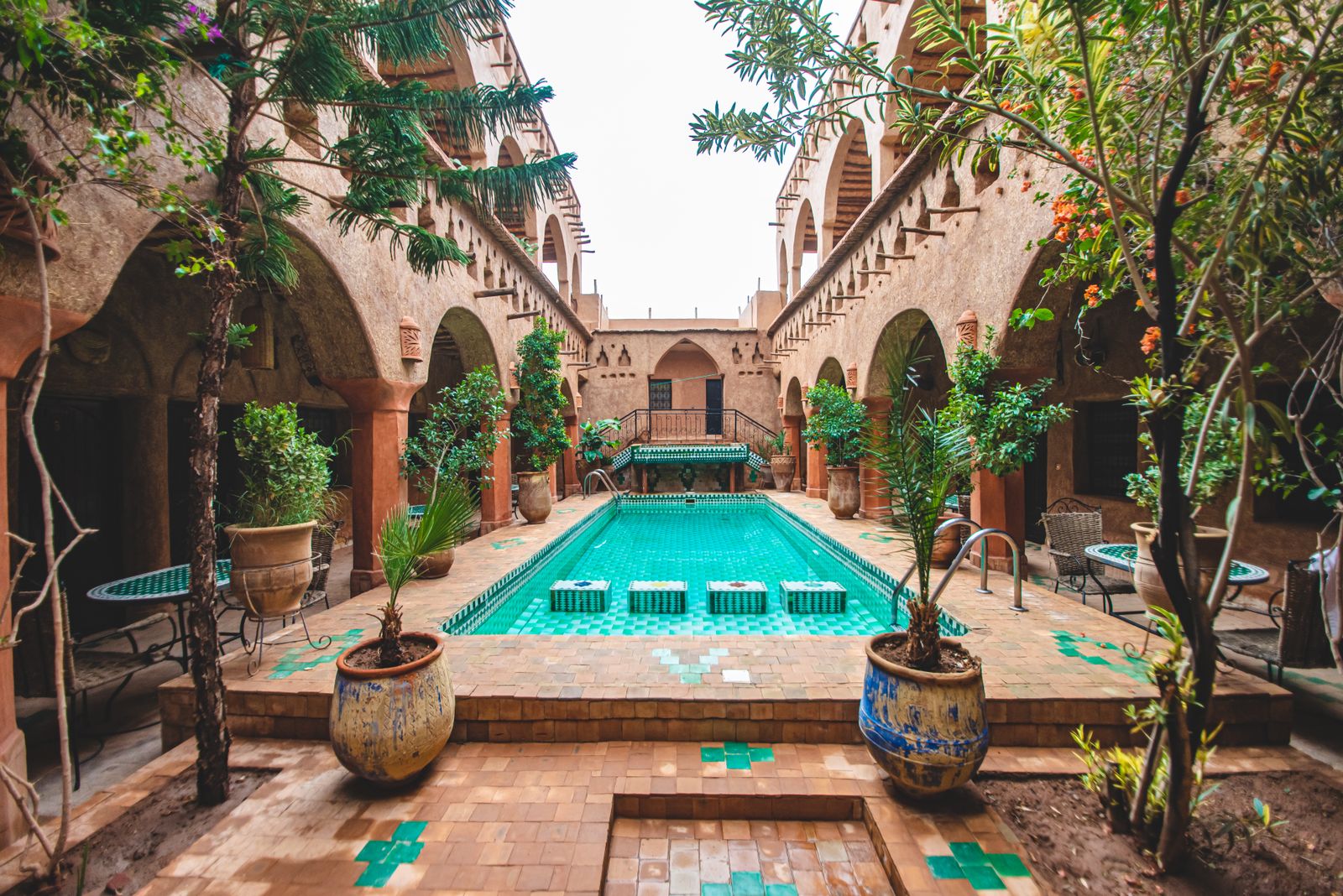
Accommodation for Morocco World Cup 2030 will be the single biggest factor in your total trip cost — and the single biggest challenge to sort out. Prices will surge 2–4× above normal levels. The best riads and hotels will sell out years in advance. This guide covers what to book, where to stay in each host city, and the strategies that will save you the most money.
What Type of Accommodation Exists in Morocco?
Riads — the Moroccan original
A riad is a traditional Moroccan house built around a central courtyard with a fountain. In Marrakech, Fes, and other medina cities, riads are the quintessential accommodation experience — beautiful, intimate, and completely different from any hotel. They range from budget (shared dorm-style rooms, $15/night normally) to ultra-luxury boutique (private pools, personal service, $400+/night). During the World Cup, expect mid-range riads to run $120–300/night.
Hotels
International chains (Marriott, Hilton, Mövenpick, Sofitel) are present in all host cities and will be the most expensive option. They offer reliable international standards, multiple restaurants, and pools — useful if you are travelling with a group and want predictability. Expect 4-star hotels to run $250–500/night during peak World Cup periods.
Apartments / Airbnb
For longer stays or groups, apartment rentals through Airbnb or similar platforms offer more space per dollar. Kitchen access cuts food costs significantly. A well-located 2-bedroom apartment in Casablanca can sleep 4 people for $150–250/night split — significantly cheaper than 4 hotel rooms.
Hostels
Good hostels exist in all host cities. They will fill fast and prices will rise, but dorm beds will remain the cheapest option ($25–45/night during the World Cup versus $8–15 normally). They are also great for meeting other fans from different countries.
Casablanca — The Main Venue
Casablanca
Home of the Grand Stade (115,000) — venue for the biggest matches
Casablanca is Morocco's largest city and most international. The medina is worth half a day but is not the city's main draw — this is a modern commercial city, not a historic imperial one. The advantage: the widest range of international restaurants, bars with alcohol, shopping malls, and business hotel infrastructure. The alternative base strategy (Rabat) works well: Rabat is 45 minutes by train, quieter, cheaper, and has its own stadium. Stay in Rabat, attend matches in both cities.
Marrakech — The Tourist Capital
Marrakech
45,000-seat venue — most culturally rich host city
Marrakech will be the most-wanted host city and therefore the most expensive. Book early or accept paying premium prices. Staying inside the medina in a riad is strongly recommended — the experience of walking through the alleys to the souks and main square is genuinely extraordinary and is most of the reason to come to Marrakech at all. The Gueliz neighbourhood (new town) has more hotel options at lower prices with easier road access to the stadium.
Rabat — The Smart Choice
Rabat
52,000-seat venue — capital city, underrated and easier to navigate
Rabat is the insider pick. Morocco's capital is genuinely beautiful — UNESCO medina, Hassan Tower, the Chellah — and almost entirely unaffected by mass tourism compared to Marrakech. Prices will be lower, the city is calmer, and you can attend matches in both Rabat and Casablanca by train. If you're attending group-stage matches at both venues, Rabat makes the most strategic sense as a base.
Tangier, Fes, and Agadir
Tangier — accommodation pressure will be high given the cross-border fan traffic from Spain (ferry crossing is 35 min). The Ville Nouvelle (new town) has the most hotel options. Medina riads exist but are fewer and less polished than Marrakech's.
Fes — the Fes el-Bali medina has the best riads outside Marrakech, and the city is far less overrun. Prices will surge but from a lower baseline. Fans who want a genuinely Moroccan experience at a fraction of Marrakech's prices should strongly consider Fes. The stadium is new, the city is magnificent.
Agadir — beach resort hotels dominate. Plenty of inventory, pool access, international standards. The city lacks cultural depth but the beach is excellent and the infrastructure is designed for mass tourism. Ideal for fans travelling with families or those who want reliable comfort over authenticity.
Booking Strategy
- Book now with free cancellation — this is the single most important thing. The good options go first.
- Contact riads directly — WhatsApp or email the riad directly. You get better prices and a direct relationship with the owner. Search for riads on Booking.com or Airbnb, then contact them off-platform.
- Consider apartment rentals for groups — 4+ people travelling together save significantly on a 2- or 3-bedroom apartment versus 4 hotel rooms.
- Match night arrivals — if your flight arrives on match day, negotiate a late check-in or early check-out with your accommodation in advance. Match-day taxis will be busy.
- Travel insurance — book accommodation with free cancellation and purchase travel insurance that covers your flights. Unexpected events are more costly when accommodation is pre-paid and non-refundable.
Related Articles
- Morocco World Cup 2030 Stadiums Guide →
- Morocco World Cup 2030 Budget Guide →
- Morocco 2030 Fan Travel Guide →
- Marrakech Riad Guide →
- Morocco Accommodation Picks →
Morocco Unveiled Travel Bible
218 pages — every host city covered in detail: neighbourhood guides, the best riads by budget, what's within walking distance of each stadium, and local restaurant picks.
Get the Guide →