In This Article
The train from Casablanca takes 45 minutes. The passengers are mostly Moroccan commuters — government workers, university students, businesspeople in well-cut suits. There are almost no tourists. The man next to me was reading a French philosophy journal. Someone's child was eating a bag of briwats. It felt, refreshingly, like a normal city.
That is exactly what Rabat is: a normal city that happens to contain extraordinary things. Morocco's capital has four UNESCO World Heritage Sites, a world-class contemporary art museum, one of the most beautiful kasbahs in North Africa, and a medina so untouched by tourism that you can walk through it without a single person trying to sell you a carpet.
Most visitors give it three hours between trains. I am here to argue for three days.
Why Everyone Ignores Rabat
Rabat suffers from a specific form of travel injustice: it is sandwiched between two more famous cities. Casablanca is 45 minutes south (Hassan II Mosque, modern Morocco). Fes is three hours east (the world's greatest medieval city). Most itineraries position Rabat as a brief transit stop between the two.
The result: the capital city of a major country — a UNESCO World Heritage urban landscape, home to 2 million people and some of Morocco's finest cultural institutions — is systematically overlooked by the travellers who would benefit most from it.
That oversight is beginning to correct itself. Rabat was named African Capital of Culture in 2022. The Mohamed VI Museum of Modern and Contemporary Art, which opened in 2014, has established a genuine international reputation. Hotel investment has accelerated. But for now, the city remains extraordinarily uncrowded by the standards of what it contains.
The Stress-Free Medina
Rabat's medina is the most relaxed in Morocco's imperial cities. Full stop.
You can walk through it — photography out, pace unhurried — and experience something that has become almost impossible in Marrakech and requires considerable resilience in Fes: being a tourist without being made to feel like a target. Nobody follows you. Nobody steers you toward their cousin's carpet shop. Nobody grabs your arm.
This is partly because Rabat's medina is genuinely a residential and working neighbourhood rather than a tourist economy. The people you pass are going to work, to market, to visit family. The souk is real — fabrics, produce, hardware, food — rather than constructed for visitor consumption.
Chellah — Morocco's Best-Kept Secret
If you see one thing in Rabat, see the Chellah at dusk. I have been to extraordinary places. Very few have moved me the way this did.
The Chellah is a walled enclosure on the southern edge of the city containing, improbably, both a Roman city (Sala Colonia, 2nd century AD) and a medieval Islamic necropolis (14th century, Merinid dynasty). The combination — Roman stonework, crumbling mosque minarets, stork nests on every available pinnacle, swallows wheeling against the late light — is genuinely unreal.
🏛️ Chellah Necropolis
Roman ruins dating from the 2nd century AD, overlaid with a 14th-century Islamic necropolis and the tombs of Merinid sultans. A colony of storks nests here year-round. Eels in the sacred pool are fed by visitors. One of the strangest and most beautiful sites in Morocco.
World-Class Culture
Mohamed VI Museum of Modern & Contemporary Art
Opened 2014, this is one of the finest contemporary art museums in Africa — full stop. The permanent collection spans Moroccan modernists from the 1950s onward, including Mohammed Melehi, Farid Belkahia, and Mohamed Chebaa, whose Casablanca School work rivals anything in European modernism. The temporary exhibitions are frequently international in scope. Entry: 60 MAD.
Archaeological Museum
The best Roman antiquities collection in Morocco — mostly from Volubilis (the remarkable Roman city two hours east). The bronze busts recovered there, including the extraordinary Head of Cato, are displayed here and are among the finest Roman portrait sculptures outside Italy. Entry: 20 MAD.
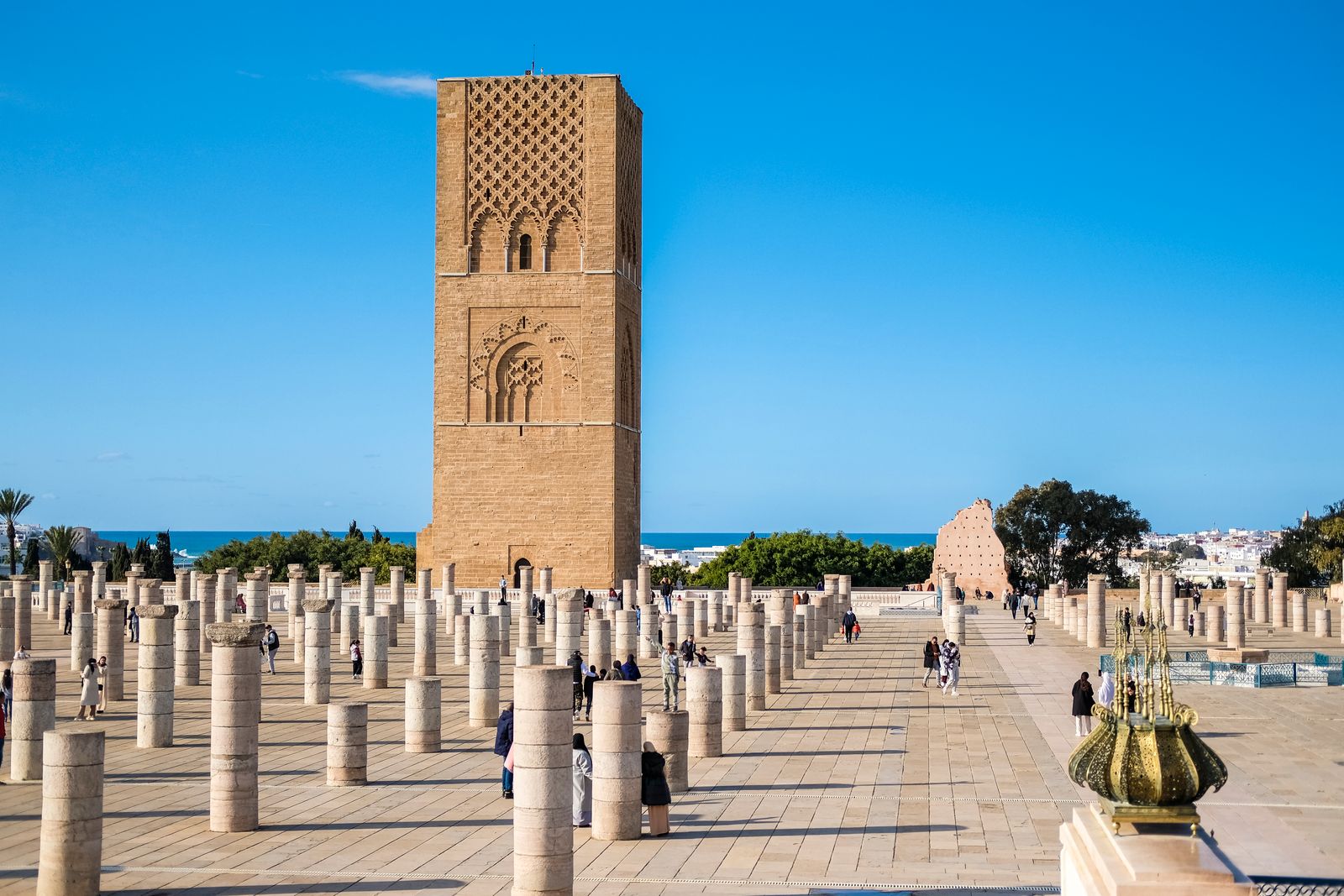
Hassan Tower
The unfinished minaret of what would have been the world's largest mosque, begun in 1195 by Almohad Sultan Yaqub al-Mansur. He died in 1199 before completion. The 344 columns of the unbuilt prayer hall remain — a forest of rose-coloured stone. The Mausoleum of Mohammed V (father of Moroccan independence) stands adjacent. Entry: free.
The Kasbah des Oudaias
The Kasbah des Oudaias is a fortified Almohad citadel from the 12th century, perched above the mouth of the Bou Regreg river where it meets the Atlantic. The main entrance gate — Bab Oudaias — is one of the finest examples of Almohad architecture anywhere.
Inside: whitewashed lanes, bougainvillea cascading over walls, a Moroccan Garden in the Andalusian style (open to visitors, perfect for an hour with a book), and the café terrace at the ocean end — arguably the best café view in Morocco. Sit with mint tea and watch the Atlantic break against the walls below as the sun goes down.
Where to Eat in Rabat
- Rue Souika — The medina's main food artery. Harira, brochettes, meloui, fresh juice — the full street food circuit. Under 50 MAD for a complete meal.
- Restaurant Dinarjat — A restored 17th-century riad in the medina serving traditional Moroccan cuisine. The most atmospheric restaurant in the city. Book ahead.
- La Bamba (Agdal quarter) — Excellent modern Moroccan with Andalusian influence. Popular with the educated Rabati middle class. 120–180 MAD.
- Café Maure — Inside the Kasbah des Oudaias, with terrace overlooking the river mouth. Order mint tea and the bastilla — it's better than it has any right to be.
Perfect Day in Rabat
Getting There & Getting Around Rabat
Rabat's great practical advantage is its position on the ONCF rail network. Trains from Casablanca run every 30 minutes (1 hour, ~40 MAD) and from Tangier via the Al-Boraq TGV (1h45). The train station (Rabat Ville) is within walking distance of the medina and Hassan Tower — you can be on the platform in Casablanca and inside the Kasbah des Oudaias two hours later.
Within the city: taxis are cheap and plentiful. The medina is walkable in 20 minutes end-to-end. The tram (Rabat-Salé tramway) connects Rabat to Salé across the river — useful for reaching the Salé medina without the rowboat crossing. Petit taxis use meters without argument — Rabat's taxi drivers are notably less combative than Marrakech or Fes.
Salé — The Other Half Nobody Visits
The city of Salé sits directly across the Bou Regreg from Rabat, connected by a 5-dirham rowboat or the tram bridge. While Rabat hosts the embassies, ministries and museums, Salé was historically the more important city — a 12th-century walled medina, its own Great Mosque, and a corsair republic in the 17th century that operated independently of both Morocco and the Ottoman Empire.
Today Salé is almost entirely tourism-free — a genuine Moroccan city where foreigners are a curiosity rather than a target. The Great Mosque of Salé is not open to non-Muslims but its exterior is extraordinary. The woodworking souks and brass workshops operate in the same buildings they've occupied for centuries. Spend two hours here; you'll feel farther from tourism than anywhere in northern Morocco.
Rabat vs. Casablanca: Which to Choose?
A common dilemma for first-time visitors to Morocco's northwest. The honest answer: they are not alternatives, they are complementary. Casablanca is a working megacity — the economic engine, modern Morocco, Hassan II Mosque, the Art Deco architecture. Rabat is the political and cultural capital — palaces, gardens, UNESCO sites, world-class museums. They are one hour apart by train. Do both.
If you must choose one as a base: Rabat is more pleasant to stay in and explore at leisure. Casablanca is better for nightlife, restaurants and the kind of modern urban energy that Rabat deliberately avoids. Rabat for history and culture; Casablanca for contemporary Morocco.